Communicate More Effectively
Express what you need, listen more fully and understand what your partner is trying to communicate.
Marriage and couples counselling in Walnut Grove, with virtual appointments available throughout British Columbia.
On a good day, under perfect conditions and with the best of intentions, relationships require work. They need maintenance, support and consideration. They are part of larger networks, affected by our health, our jobs, our children, our families and everything else happening around us. Even when all of life's moving parts are working perfectly, relationships can be challenging.
But add in all of life’s struggles - job loss, health setbacks, financial pressure and outside interference—and the strain can be enormous. Things you didn’t choose and cannot control can change the trajectory of your relationship.
Relationships also carry agreements that were made a long time ago. Some were spoken explicitly. Others developed quietly through habits, expectations and assumptions about who would do what, what each person needed and how the relationship would work. Some of those agreements may have been formed decades ago, before either of you had the experience to know what your lives would eventually require.
When those agreements stop working but remain unspoken, the meaning you give each other's behaviour can begin to change. What was once endearing becomes irritating. What was once understood as helpful begins to feel intrusive or destructive. Resentment can build, affection can become harder to access, and the person you chose to build a life with can suddenly seem incompatible with the life you are living now.
You may experience one of these pressures or several at once, eventually reaching a point where the person you come home to feels like more work than company. This is often where couples and marriage counselling begins.
Nobody comes into a relationship empty-handed. You enter with a history that existed long before the relationship began. That history starts with your family of origin, where you first learned how relationships work: how people communicate, express affection, handle conflict, divide responsibilities and respond when something goes wrong. Then life adds its own experiences. Previous relationships, losses, betrayals, disappointments, successes and periods of anxiety, depression or trauma can all become part of what you eventually bring with you.
Those experiences can influence what you expect from a partner, how you respond to conflict, what makes you feel secure and what you do when you feel hurt or threatened.
Over time, two individual patterns begin interacting with each other. One person's response produces a response from the other, which then influences what happens next. And the cycle continues. The same disagreement can play out repeatedly, even when the subject changes, because the pattern underneath it remains remarkably similar.
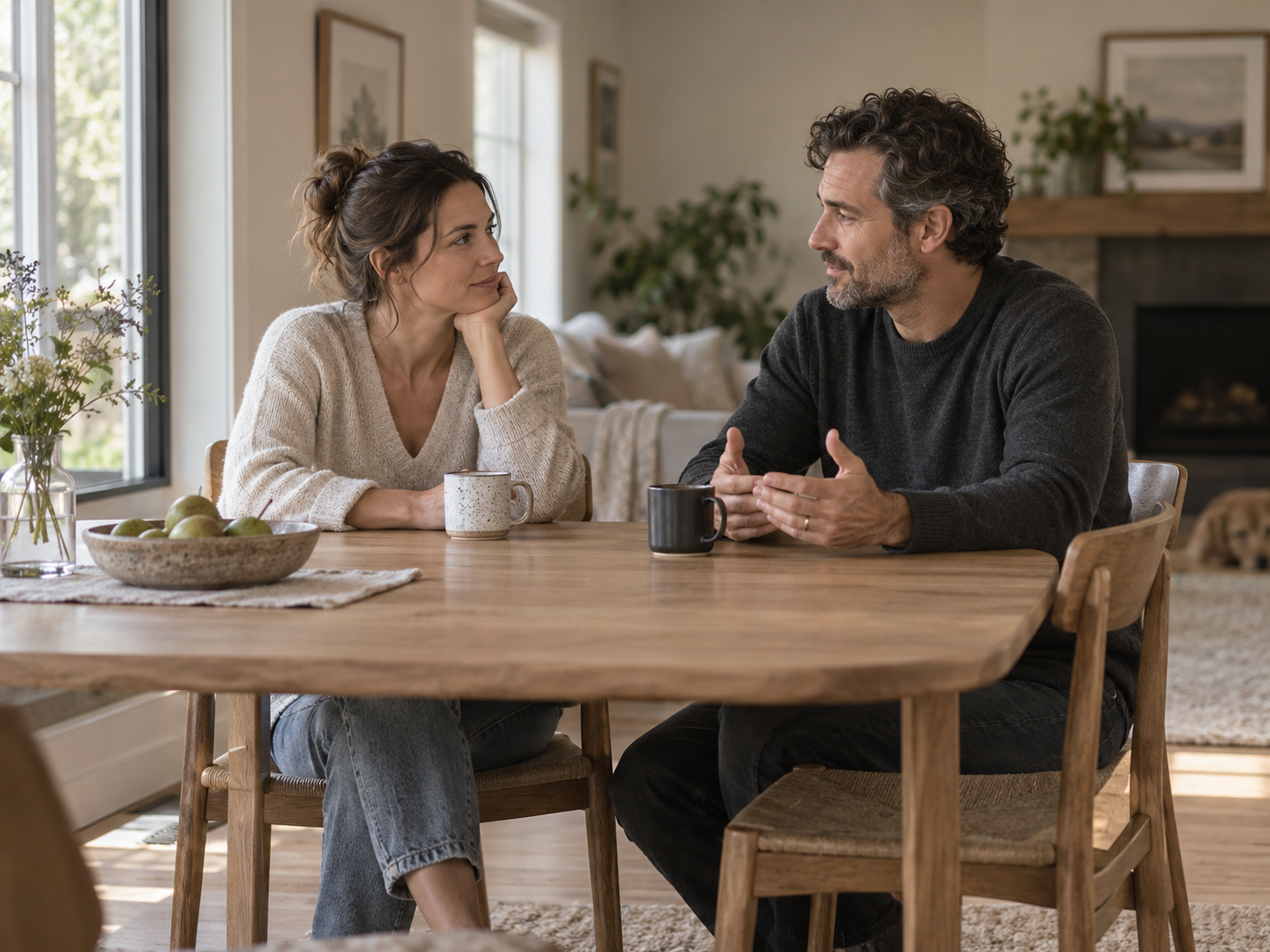
Couples counselling brings the relationship into focus. Together, we look at the patterns, preferences and histories that you and your partner bring to it and how they interact. As we understand what is creating difficulty, we can begin forming new agreements that reflect your lives, your needs and the people you have become. These conversations take into account who you are today, not who you were when you entered the relationship.
From there, we can work towards better communication and problem-solving, find better ways to negotiate disagreements and create a relationship that feels more attentive to the needs of both partners. The aim is to strengthen what is already working while developing new ways of approaching old problems.
And somewhere within that process is the opportunity to fall in love with who your partner is today and create space for them to do the same. Not an idealized version of who they could have been or might someday become, but the imperfect and trying version. The scarred but still capable version. This kind of falling in love isn't necessarily like the movies. It is a slow and intentional choice made over time, grounded in knowing each other more fully and choosing to move forward together.
Marriage counselling gives us a chance to slow things down, understand what is happening between you and try different ways of responding.
We identify what tends to happen when things go wrong: what starts the interaction, how each of you responds and how the same pattern keeps repeating.
We look at the expectations, assumptions and emotions underneath the pattern. This can help explain why the same situation may mean something very different to each of you.
We examine the conclusions you are drawing about each other's behaviour and consider other explanations. A partner who appears uncaring may be overwhelmed. Someone who seems controlling may be trying to create certainty. Understanding the difference can change the conversation.
We develop and practise ways to communicate, solve problems, express difficult feelings and respond differently when familiar situations arise.
We notice the changes that improve the relationship and reinforce them, while continuing to strengthen the things you already do well together.
Every relationship has different pressure points. We focus on the parts of your relationship that need attention while building on the strengths that already exist between you.
Express what you need, listen more fully and understand what your partner is trying to communicate.
Recognize the patterns that keep producing the same arguments and develop more constructive ways of responding to each other.
Rebuild closeness, affection and attentiveness when distance has developed between you.
Address experiences that have damaged trust and develop the consistency and communication needed to strengthen it.
Recognize how experiences from your family of origin and previous relationships influence expectations, reactions and patterns within your relationship today.
Revisit responsibilities, expectations and agreements so they reflect what each partner needs and contributes today.
Adjust expectations and responsibilities as careers, health, finances, parenting and other circumstances change.
Create room for thoughtful conversations about important decisions when you disagree about what should happen next.
Strengthen communication, decision-making and cooperation around parenting while managing differences in parenting styles and priorities.
Navigate new roles, relationships, loyalties and expectations as separate families become part of a larger family system.
Adapt together through changes such as marriage, parenthood, career changes, illness, loss, retirement or other significant transitions.
Address the ways work, finances, extended family, health and other pressures are affecting the relationship.
Relationship difficulties often overlap with challenges one or both partners are experiencing individually. These concerns can affect how you communicate, respond to conflict, experience closeness and participate in the relationship. Where relevant, we can address these alongside the relationship itself.
Different parts of a relationship can benefit from different therapeutic approaches. I draw from several approaches depending on what is happening between you, what each of you brings to the relationship and what we are trying to accomplish together.
We might use one approach for much of our time together or draw from different approaches as your needs change. Each gives us different ways to understand what is happening, develop skills, resolve problems and create change within the relationship.
Couples often arrive at counselling with different ideas about what is wrong, why it is happening and what needs to change. You do not need to agree on the problem before you come in. Those different perspectives are part of what we explore together.
My role is to understand the relationship from both perspectives and help you have conversations that are difficult to have on your own. Both partners have an opportunity to speak, ask questions and explain their experience. I help slow conversations down when needed, clarify what is being communicated and keep our attention on the goals that brought you to counselling.
We will establish what each of you would like to accomplish and identify the areas where your goals overlap. As counselling continues, we pay attention to what is changing, what remains difficult and what you can practise between sessions to help those changes carry into everyday life.
Because couples counselling involves more than one person, confidentiality works differently than it does in individual counselling. We will discuss confidentiality, communication outside of sessions and how information shared individually will be handled so that both of you understand the expectations from the beginning.
I offer couples and marriage counselling from my private office in Walnut Grove, as well as virtual appointments throughout British Columbia.
Both partners can attend together in person or join virtually from a private location. Online counselling can also accommodate partners who are in different locations, making it easier to attend when work, travel or other responsibilities make meeting in the same place difficult.
Couples counselling is designed around working with the relationship, so it is most useful when both partners participate. There may also be circumstances where one partner attends individually or where we decide an individual appointment would be useful as part of the counselling process.
You can still come to counselling on your own. While you cannot change another person's behaviour, you can better understand what is happening in your relationship, consider the choices available to you and work on how you communicate and respond within it.
There may be times when an individual appointment is useful within the broader counselling process. If we decide to meet individually, we will discuss how those conversations fit within couples counselling and how information and confidentiality will be handled.
That is okay. Couples often experience the same relationship very differently. You do not need to agree on what the problem is before coming to counselling. Understanding both perspectives can help us identify what is happening between you and where change is possible.
Couples counselling is confidential within the professional and legal limits of confidentiality. Because more than one person is involved, there are additional considerations around information shared during joint and individual conversations. I will explain how confidentiality works at the beginning so both partners understand the expectations.
Yes. I offer virtual couples counselling throughout British Columbia. You can attend together from the same location or join the appointment separately from different private locations.
Yes. Sometimes the question bringing a couple to counselling is whether the relationship should continue. Counselling can give you space to understand what has happened, explore what each of you wants and consider your options thoughtfully. The decision remains yours; my role is to help you have the conversations and develop the clarity needed to make it.
You don't need to agree on everything before you begin. You can arrive with different perspectives, different concerns and even different ideas about what needs to change. We can start by understanding where your relationship is today and what each of you hopes could be different.